


Anti-Hazing Policy FAQs
Anti-Hazing Policy FAQs
This page provides answers to common questions about Western University of Health Sciences’ Anti-Hazing Policy. The information below is intended to help students, employees, and student organizations understand what hazing is, how to report concerns, what happens after a report is made, and what prevention and accountability measures are in place.
WesternU prohibits hazing in all forms. Hazing can happen in recognized or unrecognized student organizations, teams, clubs, or other groups, and it may occur whether or not someone appears willing to participate. Because hazing can create serious physical, psychological, academic, and community harm, WesternU requires hazing concerns to be reported and addressed promptly.
For ease of use, the FAQs are organized into topic-based sections.
What Counts as Hazing?
What is hazing under WesternU’s policy?
There are various definitions of hazing depending on which law is being considered. For purposes of this Policy, and in alignment with applicable law, WesternU has adopted the following definition of Hazing:
Hazing means any intentional, knowing, or reckless act or method committed by a person (whether individually or in concert with other persons) against another person or persons, including current, former, or prospective students, regardless of the willingness of such other person or persons to participate, that is committed in the course of a pre-initiation, an initiation into, an affiliation with, or the maintenance of membership in an official or unofficial student organization, club, or body, and that:
a) causes or creates a risk of physical or psychological injury above the reasonable risk encountered in the course of participation in the institution of higher education or the organization; or
b) the initiator knows or should have known is likely to cause serious bodily injury to any former, current, or prospective student.
Hazing includes, but is not limited to, the following:
(a) whipping, beating, striking, electronic shocking, placing a harmful substance on someone’s body, or similar activity;
(b) causing, coercing, or otherwise inducing sleep deprivation, exposure to the elements, confinement in a small space, extreme calisthenics, or other similar activity;
(c) causing, coercing, or otherwise inducing another person to consume food, liquid, alcohol, drugs, or other substances;
(d) causing, coercing, or otherwise inducing another person to perform sexual acts;
(e) any activity that places another person in reasonable fear of bodily harm through the use of threatening words or conduct;
(f) any activity against another person that includes a criminal violation of local, State, Tribal, or Federal law; and
(g) any activity that induces, causes, or requires another person to perform a duty or task that involves a criminal violation of local, State, Tribal, or Federal law.
Does it still count as hazing if someone agrees to it or says it’s voluntary?
Yes. Under the policy, hazing can still be hazing even if someone appears willing to participate. A person’s willingness does not make conduct acceptable if it creates or risks physical or psychological harm or is part of initiation, affiliation, or membership pressure.
What are some examples of hazing?
Hazing can include physical abuse, sleep deprivation, forced or coerced consumption of alcohol, drugs, food, or other substances, confinement, extreme physical activity, threats, humiliating or degrading treatment, forcing someone to perform sexual acts, or requiring someone to do something illegal or dangerous. Hazing can be physical, psychological, social, or coercive.
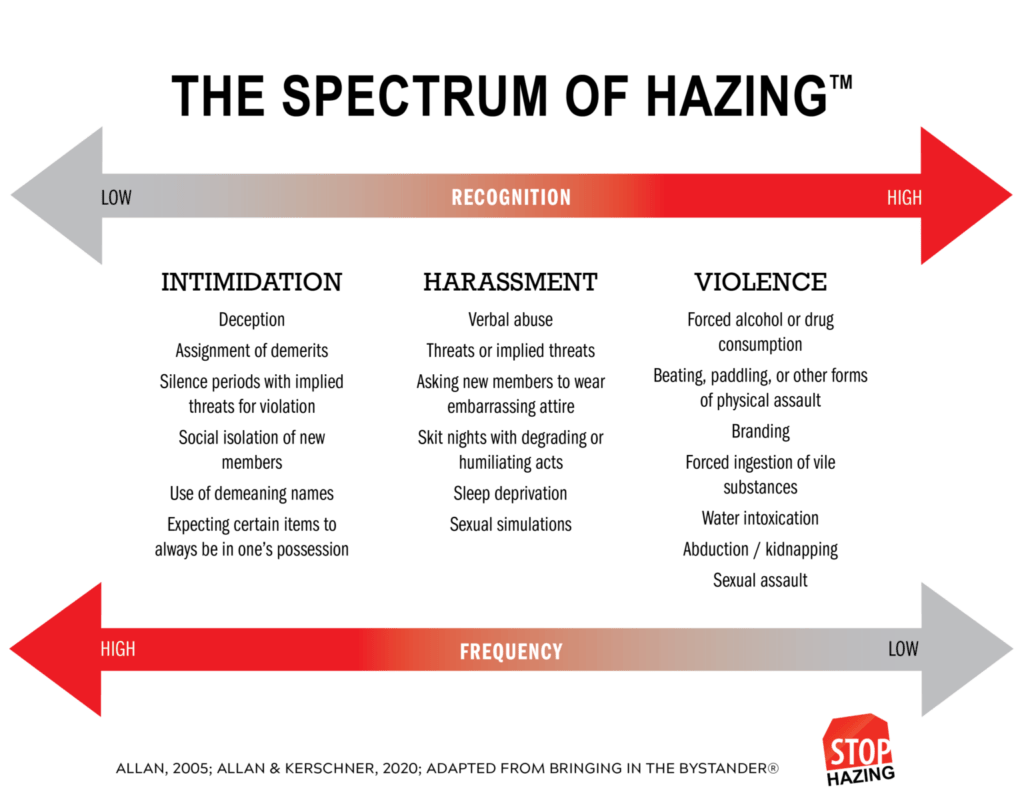
What is the Spectrum of Hazing™?
The Spectrum of Hazing™ is a research-based resource developed by StopHazing researchers Dr. Elizabeth Allan and Dr. Dave Kerschner. It illustrates hazing behaviors across three categories—intimidation, harassment, and violence—and highlights an important pattern: behaviors that occur more frequently may be less likely to be recognized as hazing, while more severe forms of hazing may be easier to identify.
The Spectrum can help individuals recognize that hazing is not limited to extreme or physically violent acts. Behaviors involving intimidation, humiliation, social pressure, or harassment may also be part of hazing and can escalate or contribute to harmful group environments.
Source: Allan, E. J. & Kerschner, D. (2020). The Spectrum of Hazing™, StopHazing Consulting.
Does hazing only apply to officially recognized student organizations?
No. The policy applies to both official and unofficial student organizations, clubs, or bodies, including groups that are not formally recognized by WesternU.
Are team bonding, traditions, or harmless pranks ever considered hazing?
Sometimes, yes. If an activity is connected to joining, staying in, or gaining status within a group and it causes or creates a risk of harm, humiliation, coercion, or intimidation, it may be hazing even if members describe it as tradition, bonding, or “just how things are done.”
Reporting and Immediate Safety
Who is required to report hazing?
Any member of the WesternU community who experiences, witnesses, or suspects hazing is required to report it to the university. If you are unsure whether something “counts,” the policy encourages you to report anyway.
How can I report hazing?
Hazing concerns can be reported through the university’s online reporting form, by email to the university office responsible for Title IX and equal opportunity compliance, or to law enforcement in urgent situations or if criminal activity is suspected.
Can I report anonymously?
Yes. To make an anonymous report, please call the Hazing Hotline at (909) 865-2620. Anonymous reports may limit the university’s ability to investigate fully, but they can still help the university assess concerns, identify patterns, and respond where possible.
What should I do if there is immediate danger or a medical emergency?
If there is an urgent safety risk, medical emergency, or possible criminal conduct, contact emergency services or law enforcement right away. Immediate safety should always come first.
What Happens After a Report?
What happens after hazing is reported?
Once a hazing concern is reported, the university reviews the information, assesses the nature of the allegation, and determines the appropriate next steps under the policy. Depending on the facts, the matter may involve safety planning, supportive measures, investigation, and referral to the appropriate process.
What if the hazing involved sex- or gender-based conduct?
If the alleged hazing is sex- or gender-based, it may be addressed under the Sexual and Gender-Based Harassment, Interpersonal Violence, and Other Sexual Misconduct (SIM) Policy instead, if the jurisdictional requirements are met.
What does the Anti-Hazing process usually include?
For non-sex- or gender-based hazing addressed under the Anti-Hazing Policy, the process typically includes an investigation and determination of responsibility, a notice of outcome, remedies or sanctions as appropriate, and an appeal process.
Who handles sanctions if a violation is found?
That depends on who the respondent is. If the respondent is a student, the matter may be referred to the appropriate college or student conduct process for sanctions. If the respondent is an employee, the matter may be referred to Human Resources and the appropriate supervisor for corrective action or discipline.
Outcomes and Retaliation
What happens if someone is found responsible for hazing?
If a hazing violation is found, the university may impose remedies, sanctions, corrective action, or other responsive measures depending on the circumstances and the respondent’s role. The outcome may also involve referral to student conduct, Human Resources, or other applicable university processes.
Can the outcome be appealed?
Yes. The policy includes an appeal process. Appeals are generally limited to the grounds and procedures outlined in the policy, and once an appeal is decided, the outcome is final.
Is retaliation prohibited?
Yes. Retaliation against any person who in good faith reports hazing, participates in an investigation, or assists in the process is strictly prohibited.
Is hazing also a crime?
Yes. Hazing may violate university policy and may also violate state or federal law. Students and employees should understand that hazing can carry both university consequences and potential legal consequences.
Prevention and Transparency
Does WesternU require hazing prevention training?
Yes. Hazing education is required for students and employees. Students are given an opportunity to complete mandatory hazing education during orientation and annually thereafter. Employees are required to complete hazing education when they are first onboarded and annually after that.
What kinds of topics are included in hazing education?
Hazing education may include identifying hazing, hazing prevention, bystander intervention strategies, ethical leadership, and building healthy group cohesion without coercion or harm.
How does WesternU share information about its Anti-Hazing Policy?
WesternU shares the policy through multiple channels, including the website, the Annual Security Report, the University Catalog, the Employee Handbook, and communications to student organizations and student leaders.
Does WesternU publish information about hazing violations?
Yes. WesternU maintains a Campus Hazing Transparency Report when required by the policy and applicable law. This report does not include personally identifying information, but it may include information about student organizations found responsible for hazing, the general nature of the violation, and related sanctions.
Where can I learn more about hazing prevention?
WesternU encourages students, employees, and student organizations to learn more about recognizing and preventing hazing. The following resources provide research, prevention strategies, educational materials, and tools for building healthier group environments:
- Hazing Prevention Resource Lab – Research and resources focused on understanding and preventing hazing.
- Hazing Prevention Tool Kit – Practical tools and strategies for hazing prevention and creating positive group cultures.
- StopHazing – Research, education, and prevention resources related to hazing and healthy group development.